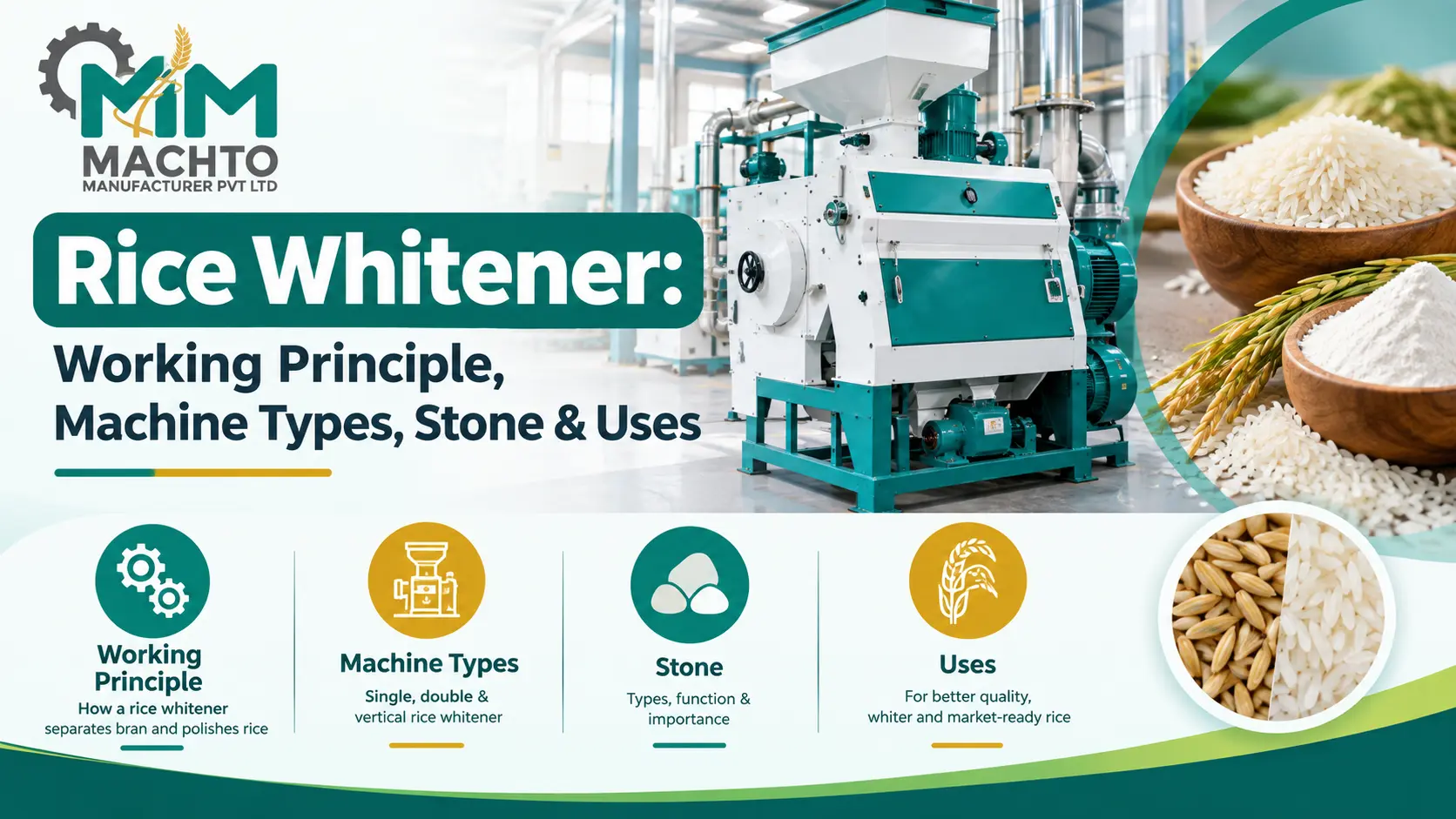
Rice processing involves several important stages that help transform harvested paddy into clean, polished, and market-ready rice. After husk removal, the rice grains still contain bran layers that need to be removed carefully. This is where a rice whitener plays an important role.
A rice whitener is designed to remove the bran layer from brown rice through controlled friction and abrasion. The machine helps achieve the desired degree of whiteness while maintaining consistent processing quality. For rice mills and processing plants, selecting the right machine, abrasive components, and operating settings is important for achieving good output with minimum grain breakage.
Machto Manufacturer Private Limited provides rice processing machinery designed for efficient and consistent grain processing applications. In this article, we will understand the rice whitener, its working principle, machine types, stone, major components, and common applications.
What Is a Rice Whitener?
A rice whitener is a rice milling machine used to remove the bran layer from brown rice after the husk has been separated. The process gives the rice a whiter appearance and prepares the grains for further processing, grading, polishing, or packaging.
During milling, the machine creates controlled rubbing and abrasion between the rice grains and the abrasive surface inside the milling chamber. This action removes the bran layer gradually.
The amount of whitening required can vary depending on the rice variety, processing requirements, and desired final product. Proper machine adjustment is therefore important to achieve consistent results.
Rice Whitener Working Principle
Understanding the rice whitener working principle helps explain how the machine converts brown rice into white rice.
After dehusking, brown rice enters the whitening chamber through an inlet. Inside the chamber, the grains are subjected to controlled friction and abrasion. As the rice moves through the chamber, the bran layer is gradually removed from the grain surface.
The main stages generally include:
- Rice feeding: Brown rice enters the machine through the feed system.
- Controlled movement: The grains move through the whitening chamber.
- Friction and abrasion: Rice comes into contact with the abrasive surface and other grains.
- Bran removal: The outer bran layer is separated from the rice kernels.
- Air movement: Airflow can help remove loosened bran and control the processing environment.
- Rice discharge: Whitened rice leaves the chamber through the outlet.
The objective is to remove the required amount of bran while reducing unnecessary pressure and grain breakage. Machine settings such as feed rate, pressure, airflow, and processing time can influence the final result.
Main Components of a Rice Whitener
A modern rice whitener consists of several components that work together to provide controlled milling.
Whitening Chamber
The whitening chamber is the main processing area where rice grains are subjected to friction and abrasion. Its design affects the efficiency and uniformity of whitening.
Abrasive Surface or Rice Whitener Stone
The rice whitener stone is an important component in abrasive-type rice whitening machines. It provides the surface required to remove the bran layer from the rice grains.
The abrasive material and stone design can influence whitening efficiency, grain quality, and operating life. The correct stone should be selected according to the machine design and processing requirements.
Feed Mechanism
The feeding system controls the movement of brown rice into the whitening chamber. Consistent feeding helps maintain stable machine performance.
Pressure Adjustment System
Controlled pressure is important because excessive pressure can increase grain breakage, while insufficient pressure may result in incomplete whitening.
Bran Collection System
As the bran layer is removed, the resulting particles need to be separated from the processed rice. Airflow and collection systems help manage the bran produced during operation.
Motor and Drive System
The motor provides the mechanical power needed to operate the rotating components. A properly selected drive system supports stable and efficient operation.
Types of Rice Whitener Machines
Different rice mills may require different types of whitening equipment depending on their production capacity and processing requirements.
Abrasive Rice Whitener
An abrasive rice whitener uses an abrasive surface to remove the bran layer. The abrasive action provides effective whitening and is commonly used in rice milling operations.
Friction Rice Whitener
A friction-type machine relies more heavily on pressure and friction between rice grains and the working surfaces. It can be used when a particular degree of whitening and grain finish is required.
Vertical Rice Whitener
In a vertical configuration, the rice moves through a vertically arranged processing chamber. These machines can offer a compact installation arrangement and are available in different capacities.
Horizontal Rice Whitener
Horizontal machines use a horizontally positioned whitening chamber. They can be incorporated into different rice milling plant layouts depending on the required process flow.
The appropriate machine type depends on factors such as rice variety, production capacity, desired whiteness, plant configuration, and overall milling process.
What Is the Role of a Rice Whitener Stone?
The abrasive component is one of the most important parts of an abrasive rice whitening system. A rice whitener stone comes into direct contact with the grains and helps remove the bran layer through controlled abrasion.
The condition of the stone can affect the consistency of the whitening process. A worn or unsuitable abrasive surface may reduce processing efficiency or produce inconsistent results.
Therefore, regular inspection and timely replacement of wear components are important for maintaining stable machine performance. The stone should always be selected according to the manufacturer’s specifications rather than simply choosing an abrasive component based on size or appearance.
Applications of Rice Whitener Machines
Rice whiteners are commonly used in rice processing facilities where brown rice needs to be converted into commercially acceptable white rice.
Typical applications include:
- Commercial rice mills
- Paddy processing plants
- Integrated rice milling lines
- Rice processing units
- Grain processing facilities
- Food processing industries
In larger milling plants, rice whiteners can be integrated with other equipment such as paddy cleaners, destoners, paddy separators, huskers, polishers, graders, and sorting systems.
Benefits of Using a Rice Whitener
A properly selected rice whitener can provide several operational benefits.
Consistent Whitening
Controlled processing helps achieve a more uniform level of bran removal across the rice batch.
Improved Appearance
Removing the bran layer gives rice a cleaner and whiter appearance, which is important for many commercial rice products.
Better Process Control
Modern equipment allows operators to adjust processing conditions according to the required output and rice characteristics.
Integration With Rice Mills
Rice whiteners can be incorporated into complete rice milling plants, allowing continuous processing from dehusking to whitening and subsequent stages.
Reduced Manual Processing
Automated machinery reduces dependence on manual grain processing and supports consistent production at commercial scale.
Factors to Consider Before Buying a Rice Whitener
Choosing a machine should involve more than simply comparing its purchase price. Consider the following factors:
- Required production capacity
- Type and variety of rice
- Desired degree of whitening
- Power consumption
- Grain breakage rate
- Machine construction
- Abrasive component quality
- Ease of maintenance
- Availability of replacement parts
- Integration with existing milling equipment
- Technical and after-sales support
A machine that matches the actual processing requirements can provide better long-term value and more consistent operation.
Why Choose Machto Manufacturer Private Limited?
Machto Manufacturer Private Limited focuses on providing machinery solutions for industrial and grain processing requirements. When selecting a rice processing machine, understanding the application, required capacity, grain characteristics, and plant configuration is essential.
The right rice whitener can help create a controlled milling process while supporting consistent grain quality. Machto Manufacturer Private Limited can assist buyers in selecting equipment according to their specific processing requirements and production setup.
Conclusion
A rice whitener is an essential machine in many rice milling processes because it removes the bran layer from brown rice and helps produce clean, commercially acceptable white rice. Understanding the rice whitener working principle, machine types, abrasive components, and operating requirements can help rice mill operators make better equipment decisions.
The right rice whitener machine should provide controlled abrasion, consistent processing, suitable capacity, and manageable maintenance requirements. Components such as the rice whitener stone also play an important role in achieving effective and uniform bran removal.
For rice mills and processing plants, selecting equipment based on actual production requirements rather than price alone can contribute to reliable performance, better grain quality, and efficient milling operations.
Also Read:
Paddy Pre Cleaner Machine
Vibro Destoner
Rice Polisher
Single Body Paddy Separator
Rice Sifter Machine
Rice Silky Machine
Gravity Separator