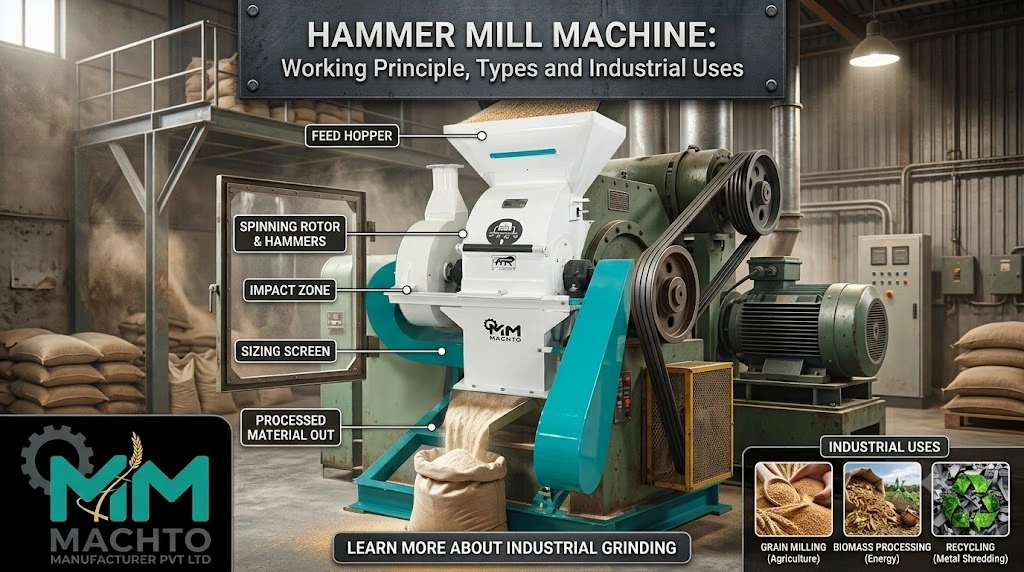
A hammer mill machine is an important piece of equipment used in agricultural processing, food production, feed manufacturing, and various industrial applications. It reduces the size of raw materials into smaller particles by using high-speed rotating hammers. From grinding grains and agricultural residues to processing other suitable materials, a hammer mill helps improve processing efficiency and maintain consistent output.
For businesses involved in grain processing, animal feed production, and industrial material preparation, choosing the right hammer mill machine can make a significant difference in productivity and operating costs. Machto Manufacturer Private Limited provides machinery solutions for grain processing and related industrial requirements, helping businesses select equipment according to their operational needs.
In this guide, we will explore the working principle, different types, key features, and industrial uses of hammer mill machines.
What Is a Hammer Mill Machine?
A hammer mill machine is a mechanical grinding system that uses rotating hammers to crush, break, and reduce materials into smaller particles. The material enters a grinding chamber, where rapidly moving hammers strike it repeatedly. Depending on the machine design, particle size is controlled through a screen, hammer configuration, rotational speed, and material properties.
Hammer mills are widely used in agricultural and industrial operations because they can process many types of suitable raw materials. They are commonly found in rice mills, feed plants, food processing facilities, and biomass processing units. The machine’s capacity, motor power, screen size, and construction depend on the material being processed and the required production output.
Also Read: Rice Whitener: Working Principle, Machine Types, Stone & Uses
How Does a Hammer Mill Machine Work?
The working principle of a hammer mill machine is based on impact grinding. The rotating hammers deliver repeated blows to the material, breaking it into smaller pieces until it reaches the required size.
The process generally involves the following steps:
1. Feeding the Raw Material
The raw material is introduced into the grinding chamber through a feeding inlet or hopper. Uniform feeding helps maintain stable operation and reduces the risk of overloading the machine.
2. High-Speed Hammer Rotation
An electric motor drives the rotor, which carries a series of hammers. As the rotor spins, the hammers move at high speed and strike the incoming material.
3. Impact and Size Reduction
Repeated impacts break the material into smaller particles. Depending on the application, additional particle reduction may occur through contact with the chamber surfaces and interaction between particles.
4. Screening the Material
Many hammer mills use a perforated screen fitted around the grinding area. Particles pass through the openings once they reach a suitable size. The screen size plays an important role in determining the final particle distribution.
5. Discharge of Processed Material
The ground material is discharged through the machine’s outlet. It can then be collected, conveyed, or transferred to the next stage of production.
This straightforward working process makes hammer mills suitable for operations that require reliable and continuous material size reduction.
Types of Hammer Mill Machines
Different hammer mill designs are available to meet varying material processing requirements. The appropriate type depends on the raw material, desired particle size, production capacity, and operating conditions.
1. Gravity Discharge Hammer Mill
A gravity discharge hammer mill allows processed material to fall through the screen and exit the grinding chamber under gravity. This design is suitable for applications where the material can move freely through the machine.
It is commonly used for processing grains, dry agricultural materials, and other suitable raw materials.
Key benefits:
- Simple operating mechanism
- Straightforward material discharge
- Suitable for various dry grinding applications
- Practical design for routine processing operations
2. Pneumatic Discharge Hammer Mill
A pneumatic discharge hammer mill uses airflow to remove processed material from the grinding chamber. The air movement helps transport fine particles through the discharge system and can support higher-throughput operations when properly designed.
This type is useful in installations where material handling, dust collection, and continuous processing are important considerations.
Key benefits:
- Efficient removal of fine particles
- Suitable for integrated conveying systems
- Supports continuous material processing
- Can be configured with appropriate dust collection equipment
3. Industrial Hammer Mill
An industrial hammer mill is designed for demanding processing environments and larger production requirements. Depending on its configuration, it can process agricultural materials, selected biomass, and other compatible raw materials.
These machines may feature heavy-duty construction, high-capacity feeding systems, and replaceable wear components.
Key benefits:
- Designed for regular industrial operation
- Available in different capacities
- Suitable for multiple material processing applications
- Can be integrated into larger production lines
4. Feed Grinding Hammer Mill
A feed grinding hammer mill is commonly used in animal feed manufacturing to reduce the particle size of grains and other suitable feed ingredients. Consistent grinding helps prepare raw materials for mixing, conditioning, and pelleting.
The correct screen size and grinding settings depend on the feed formulation, animal requirements, and downstream equipment.
Key benefits:
- Supports animal feed preparation
- Offers adjustable particle size through screen selection
- Can be integrated into feed production plants
- Helps prepare materials for subsequent processing
5. Biomass Hammer Mill
A biomass hammer mill is designed to reduce the size of suitable biomass materials, such as certain agricultural residues and other plant-based feedstocks. It is often used before briquetting, pellet production, or other biomass processing operations.
The machine must be selected according to the material’s moisture content, fibre characteristics, and required output size.
Key benefits:
- Supports biomass size reduction
- Helps prepare feedstock for further processing
- Available in different configurations
- Can form part of an integrated biomass processing line
Key Features of a Hammer Mill Machine
A well-designed hammer mill machine combines effective grinding performance with practical maintenance and safe operation. Important features to evaluate include:
- Robust construction: A strong frame and suitable grinding chamber support reliable industrial use.
- High-speed rotor: The rotor generates the impact force required for material size reduction.
- Replaceable hammers: Depending on the design, worn hammers can be replaced to maintain grinding performance.
- Screen-based particle control: Interchangeable screens allow users to adjust the approximate output size.
- Efficient motor system: Correct motor sizing helps meet processing requirements without unnecessary energy consumption.
- Easy maintenance access: Accessible wear parts simplify inspection, cleaning, and servicing.
- Suitable feeding arrangements: A properly designed feed system helps maintain consistent material flow.
- Safety provisions: Appropriate guards, emergency stops, and electrical protections help support safe operation.
Actual features vary according to the model, capacity, and application.
Industrial Uses of Hammer Mill Machines
Hammer mills are used across a wide range of industries because they can process many materials that require impact-based size reduction.
1. Rice Mills and Grain Processing
In grain processing facilities, hammer mills can be used to grind suitable grain fractions, by-products, and other materials according to the production process. They can also support the preparation of ingredients used in feed manufacturing.
The specific application should be selected carefully to avoid unnecessary breakage or damage to materials intended for whole-grain processing.
2. Animal Feed Manufacturing
Feed plants use hammer mills to grind maize, cereals, and other suitable ingredients into smaller particles. The ground material can then be blended with other ingredients before further processing.
Consistent grinding helps improve mixing uniformity and supports the production of feed with the required particle characteristics.
3. Food Processing
Certain food processing operations use hammer mills to reduce the size of dry ingredients, grains, and other compatible materials. Applications depend on hygiene requirements, product characteristics, and the machine’s food-contact design.
For food-grade applications, the equipment should use suitable materials and allow effective cleaning.
4. Biomass and Agricultural Waste Processing
Agricultural residues, selected crop by-products, and suitable plant materials can be processed in hammer mills before further conversion. Size reduction helps prepare the material for biomass briquettes, pellets, and other applications.
Material moisture, fibre content, and abrasive properties must be considered before choosing the equipment.
5. Fertilizer and Chemical Processing
Some fertilizer and chemical production processes use hammer mills to crush compatible dry materials or break down suitable agglomerates. However, not every chemical or mineral is appropriate for hammer milling.
Material compatibility, dust characteristics, heat generation, and explosion risks must be assessed before processing.
6. Pharmaceutical and Other Industrial Applications
Specially configured hammer mills can be used for certain pharmaceutical ingredients and other industrial materials. These applications may require precise particle control, validated cleaning procedures, suitable contact materials, and strict process controls.
The equipment must be selected according to the industry’s regulatory and product quality requirements.
Benefits of Using a Hammer Mill Machine
A hammer mill offers several operational advantages when matched correctly to the application.
Versatile material processing: It can handle many compatible materials across agricultural and industrial sectors.
Simple size reduction process: Impact-based grinding provides a practical method for breaking down suitable raw materials.
Flexible particle sizing: Screen selection and machine settings allow the output to be adjusted within the equipment’s operating range.
Replaceable wear components: Hammers and screens can often be replaced when worn, helping maintain performance.
Integration with production lines: Hammer mills can be connected with feeders, conveyors, dust collection systems, and downstream processing equipment.
Support for productivity: Properly selected and maintained machinery can help reduce processing bottlenecks and improve workflow.
Actual performance depends on the machine design, material characteristics, operating conditions, and maintenance practices.
How to Choose the Right Hammer Mill Machine
Before purchasing a hammer mill machine, businesses should evaluate several important factors.
- Material type: Identify whether the machine will process grains, feed ingredients, biomass, or another compatible material.
- Required capacity: Match the machine’s rated throughput to the expected production demand.
- Desired particle size: Select a suitable screen and rotor configuration for the required output.
- Motor power: Ensure the motor can handle the material and operating load.
- Material moisture: Moisture content can affect grinding efficiency, material flow, and screen performance.
- Maintenance requirements: Check the availability of replacement hammers, screens, and other wear components.
- Safety and dust control: Evaluate guarding, ventilation, dust collection, and other application-specific protections.
- Total operating cost: Consider energy consumption, maintenance, installation, and expected service requirements.
Discussing these factors with a machinery manufacturer can help identify a suitable configuration for your plant.
Why Choose Machto Manufacturer Private Limited?
Selecting an appropriate machinery supplier is an important step when planning or upgrading a processing facility. Machto Manufacturer Private Limited focuses on machinery solutions for agricultural processing and related industrial requirements.
When evaluating equipment for your operation, consider the suitability of the machine for your raw material, the required production capacity, ease of maintenance, and compatibility with your existing production line.
The team can be approached to discuss application requirements and identify the specifications that should be considered before selecting a suitable machine. Buyers should confirm the available model configurations, technical specifications, capacity, warranty, and after-sales support directly with the manufacturer.
Conclusion
A hammer mill machine is a versatile solution for reducing the size of suitable raw materials in grain processing, animal feed production, biomass preparation, and various industrial applications. Its impact-based working principle, replaceable wear components, and screen-based particle control make it a practical option for many processing operations.
However, the best results depend on selecting the correct machine type, capacity, screen size, and motor configuration for the intended material. Proper maintenance, safe operating practices, and suitable dust control also contribute to dependable performance.
For businesses planning to install or upgrade processing equipment, Machto Manufacturer Private Limited can be contacted to discuss machinery requirements and determine which specifications are appropriate for the application.
Frequently Asked Questions (FAQs)
1. What is a hammer mill machine used for?
A hammer mill machine is used to crush and grind suitable raw materials into smaller particles. Common applications include grain processing, animal feed production, biomass preparation, and selected industrial operations.
2. What is the working principle of a hammer mill?
A hammer mill works on the principle of impact grinding. High-speed rotating hammers strike the material repeatedly until it reaches a suitable size for discharge.
3. What are the main types of hammer mill machines?
Common types include gravity discharge hammer mills, pneumatic discharge hammer mills, industrial hammer mills, feed grinding hammer mills, and biomass hammer mills.
4. Which factors affect hammer mill performance?
Material type, moisture content, rotor speed, screen size, hammer condition, feed rate, and motor capacity can all affect grinding performance.
5. How do I select the right hammer mill machine?
Choose a machine based on the material to be processed, required capacity, target particle size, motor power, maintenance needs, and applicable safety requirements.
6. How can I maintain a hammer mill machine?
Inspect hammers and screens regularly, keep the machine clean, follow the manufacturer’s lubrication schedule, check bearings and fasteners, and follow lockout procedures before maintenance.
7. Is a hammer mill suitable for biomass processing?
Yes, a suitably designed hammer mill can process compatible biomass materials to prepare them for applications such as pellet and briquette production. The machine must be matched to the feedstock’s moisture, fibre content, and required output size.