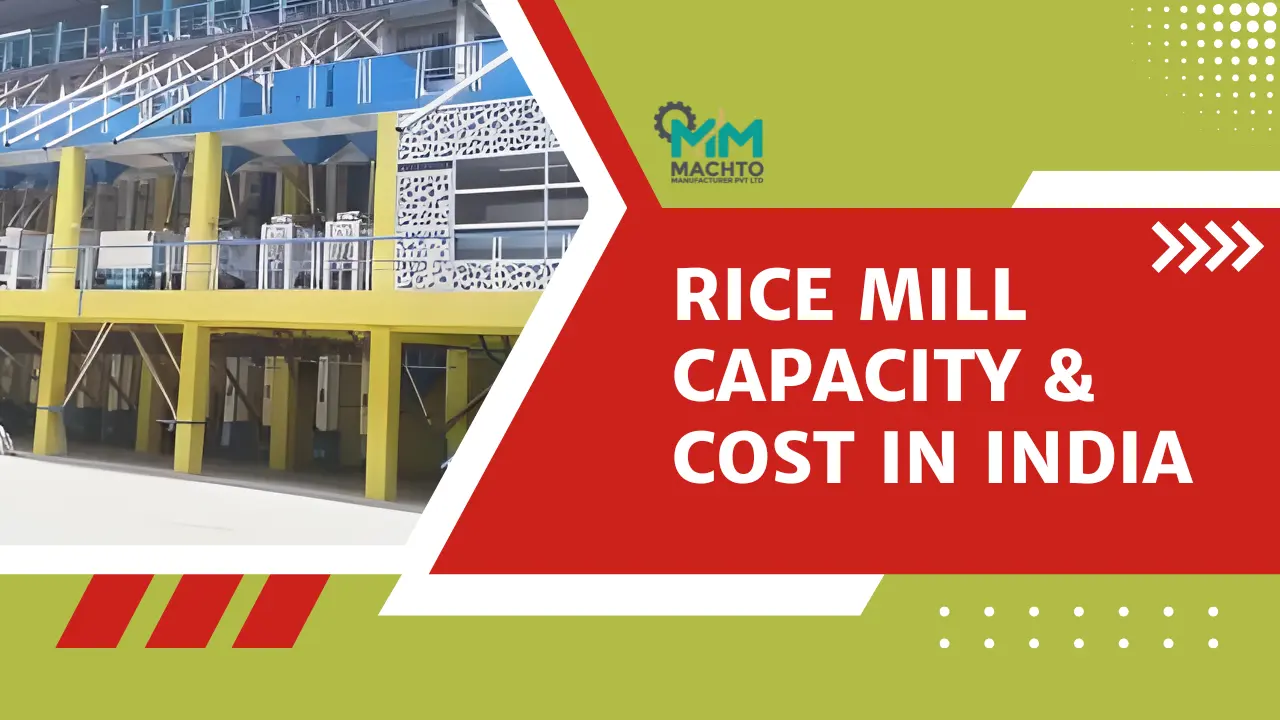
Machto Manufacturer Pvt. Ltd. believe that the right planning at the beginning can save both money and effort later. This guide will help you understand rice mill capacity and its cost in a simple and practical way.
What is Rice Mill Capacity?
Rice mill capacity simply refers to how much paddy your plant can process in one hour. It is measured in tons per hour (TPH). For example, a 1-ton rice mill can process around 1000 kg of paddy in one hour, while a 10-ton plant can handle much larger production.
As capacity increases, production grows, but so does the investment, space requirement, and operational complexity. That is why choosing the right capacity is a crucial decision for any business owner.
Also Read: How Much Startup Cost of Rice Mill Business in India
Understanding Capacity Levels in Rice Mills
Rice mills in India are generally divided into three broad categories based on their capacity. Small capacity mills usually range from 1 to 3 tons per hour and are best suited for local markets or beginners. These setups require lower investment and are easier to manage.
Medium capacity rice mills typically fall between 4 to 10 tons per hour. These are ideal for businesses that want to expand and serve a larger market. They often include semi-automatic or fully automatic systems, offering better efficiency.
Large capacity mills, ranging from 10 to 100 tons per hour, are used for industrial-scale production. These plants are highly automated and are commonly used by exporters and large suppliers.
2 Ton Rice Mill Project Cost
If you are just starting your business, a 2 ton rice mill is often considered a safe and practical choice. The 2 ton rice mill project cost in India generally falls between ₹15 lakh to ₹30 lakh, depending on the machinery quality and level of automation.
This type of setup works well for small entrepreneurs who want to enter the market with a limited budget. It does not require very large space or heavy manpower, making it easier to operate and maintain. Many first-time business owners prefer this capacity because it allows them to learn the process while generating steady income.
10 Ton Rice Mill Project Cost
As your business grows, you may consider upgrading to a larger plant. A 10 ton rice mill offers a significant increase in production and efficiency. The 10 ton rice mill project cost usually ranges from ₹50 lakh to ₹1.5 crore or more, depending on the technology used.
This capacity is suitable for businesses that have a strong market demand and want to scale operations. With better automation, production becomes faster and more consistent. Although the investment is higher, the profit potential also increases due to higher output and improved quality.
100 Ton Rice Mill Project Cost
For large-scale industrial operations, a 100 ton rice mill is the ultimate setup. The 100 ton rice mill project cost can go from ₹5 crore to ₹15 crore or even higher, depending on the plant configuration and additional equipment.
Such plants are designed for continuous, high-volume production and are commonly used by exporters and large food processing companies. These systems are fully automatic and require proper planning, skilled staff, and a strong supply chain to operate efficiently.
What Affects Rice Mill Price?
The rice mill price is not fixed and can vary widely depending on several factors. Capacity is the most obvious factor, as larger plants require more machinery and infrastructure. The type of automation also plays a big role, with fully automatic systems costing more than semi-automatic ones.
Apart from that, the quality of machinery, brand reputation, and additional features such as color sorters or dryers can increase the overall cost. Installation expenses, including civil work and electrical setup, also add to the final investment.
Machinery Used in a Rice Mill
A complete rice mill plant is made up of several machines that work together to convert paddy into finished rice. The process starts with cleaning and removing impurities, followed by de-stoning and husking. After that, the rice goes through separation, whitening, polishing, and grading stages.
In advanced setups, machines like color sorters are used to improve the final product quality. Each stage plays an important role in ensuring efficiency and minimizing wastage.
Choosing the Right Capacity for Your Business
Selecting the right capacity depends on your budget, market demand, and future goals. If you are starting small, it is always better to begin with a lower capacity plant and upgrade later as your business grows.
On the other hand, if you already have strong demand and sufficient capital, investing in a medium or large capacity plant can help you achieve faster growth. The key is to balance investment with expected returns.
Profit Potential in Rice Mill Business
The rice mill business offers good profit potential, especially when managed properly. Higher capacity mills generally earn more due to larger production volumes, but they also involve higher risk and investment.
Consistency in quality, efficient operations, and proper market strategy are essential to maximize profit. With the right setup, even a small rice mill can become a successful and sustainable business.
Why Choose Machto Manufacturer Pvt. Ltd.?
Machto Manufacturer Pvt. Ltd. is committed to providing reliable and customized rice mill solutions. We understand that every client has different requirements, and we design plants accordingly.
Our focus is on delivering high-quality machinery, smooth installation, and long-term support. Whether you are starting a small unit or planning a large industrial plant, we guide you at every step to ensure your success.
Final Thoughts
Understanding rice mill capacity and cost in India is the foundation of building a successful rice mill business. From a 2 ton rice mill project cost for beginners to a 100 ton rice mill project cost for large industries, every level has its own benefits and challenges.
The right decision depends on your goals, budget, and long-term vision. With proper planning and the right partner, you can build a profitable business in this growing industry.