Rice is one of the world’s most consumed staple foods, and maintaining its nutritional value and milling quality is a top priority for rice processors. One of the most effective methods to improve rice quality before milling is parboiling. This process not only enhances the strength of rice grains but also increases milling efficiency and reduces grain breakage.
A modern parboiling plant is designed to carry out the complete parboiling process under controlled conditions, ensuring consistent quality and high production capacity. Whether you’re planning to establish a new rice mill or upgrade your existing processing line, understanding how a paddy parboiling plant works can help you make better operational decisions.
In this blog, we’ll explain the complete parboiling of rice process, its advantages, major equipment used, and why investing in a modern parboiling plant is beneficial for commercial rice production.
What is a Paddy Parboiling Plant?
A paddy parboiling plant is an integrated system that treats raw paddy with water and steam before the milling process. The objective of parboiling is to partially cook the paddy while it is still inside the husk. This strengthens the grain, preserves nutrients, and improves milling performance.
Unlike conventional rice processing, parboiling of rice changes the physical structure of the grain by allowing vitamins and minerals from the outer bran layer to move into the kernel. As a result, the finished rice becomes stronger, more nutritious, and less likely to break during milling. Modern parboiling plants are widely used by commercial rice mills because they improve both rice quality and overall plant productivity.
Also Read: What is a Gravity Separator Machine? Working, Uses & Benefits
Why is Parboiling of Rice Important?
The parboiling process offers several benefits that directly impact rice quality and profitability.
Some of the major advantages include:
- Higher head rice recovery
- Reduced broken rice percentage
- Better nutritional value
- Improved grain hardness
- Longer storage life
- Attractive rice appearance
- Better resistance to insects during storage
- Increased milling efficiency
These advantages make parboiled rice highly preferred in many domestic and international markets.
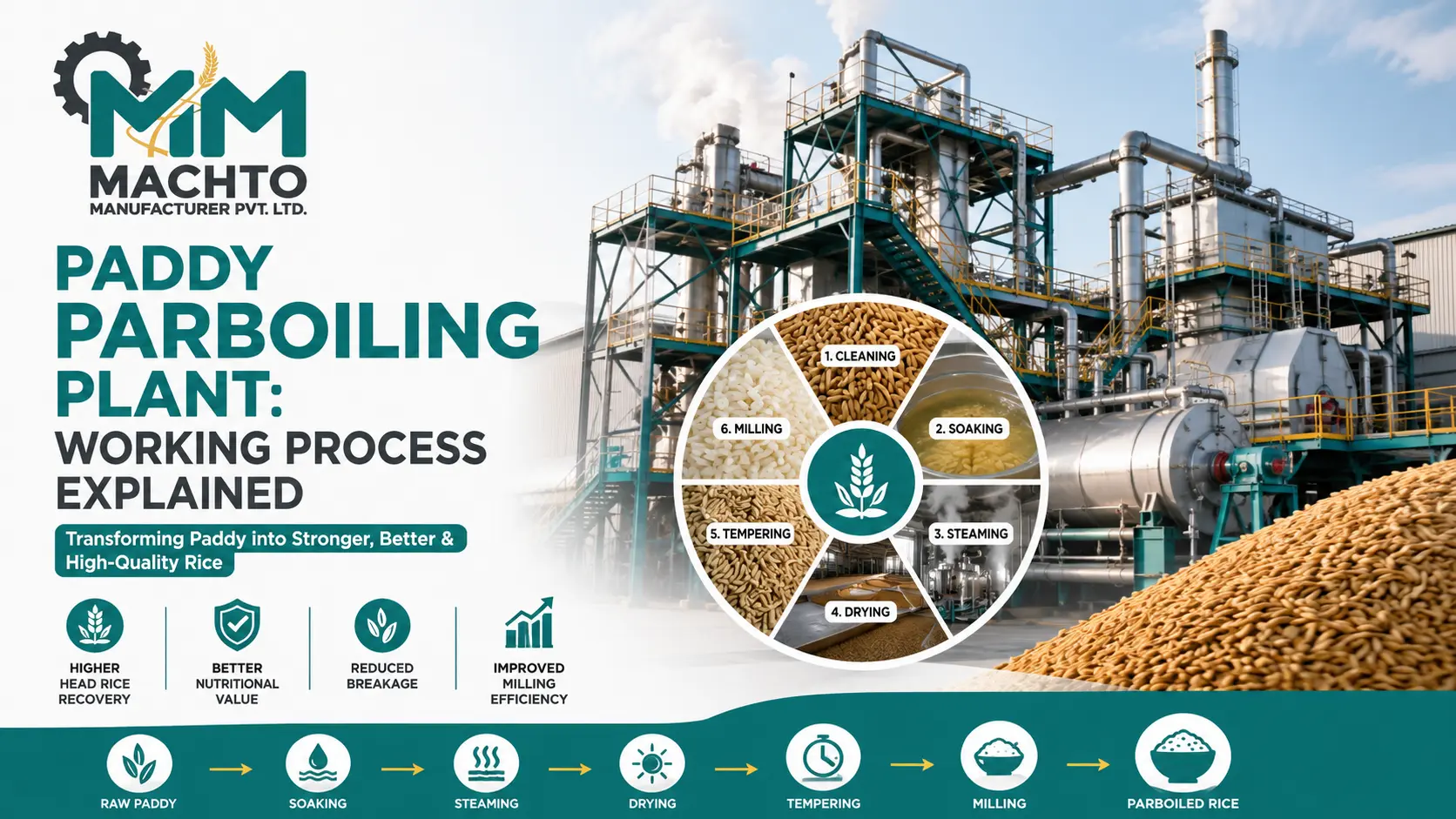
Working Process of a Paddy Parboiling Plant
The complete parboiling of rice consists of several carefully controlled stages. Each stage plays an important role in producing high-quality parboiled rice.
Step 1: Paddy Cleaning
The first stage begins with cleaning the raw paddy. Dust, stones, straw, metal particles, and other foreign materials are removed using equipment such as:
- Pre Cleaner
- Vibro Destoner
- Magnetic Separator
Cleaning protects downstream machinery and ensures efficient processing.
Step 2: Soaking Process
After cleaning, the paddy is transferred into soaking tanks.
During this stage:
- Paddy is immersed in hot water.
- Water temperature is maintained under controlled conditions.
- Moisture gradually penetrates inside each grain.
The soaking process softens the kernels and prepares them for steaming.
The soaking duration depends on:
- Paddy variety
- Moisture level
- Plant capacity
- Desired rice quality
Proper soaking is essential for achieving uniform parboiling.
Step 3: Steaming
Once soaking is complete, the paddy enters the steaming chamber. Steam is supplied through specially designed vessels where:
- Starch inside the grain begins to gelatinize.
- Nutrients migrate toward the center of the grain.
- Grain strength increases significantly.
Steaming is one of the most critical stages of the parboiling plant because it determines the final quality of rice. Proper steam pressure and temperature ensure uniform treatment throughout the batch.
Step 4: Drying
Freshly steamed paddy contains high moisture and cannot be milled directly. The drying process reduces moisture to the desired level using industrial paddy dryers.
Modern dryers provide:
- Uniform moisture reduction
- Faster drying cycles
- Lower energy consumption
- Better grain quality
Controlled drying also minimizes cracks in rice kernels.
Step 5: Tempering
Tempering allows moisture to distribute evenly inside the grains before final drying or milling.
This stage helps:
- Reduce internal stress
- Improve grain strength
- Minimize breakage during milling
Many advanced parboiling plants include automatic tempering systems for consistent results.
Step 6: Rice Milling
After drying, the paddy is transferred to the rice mill where it passes through several machines, including:
- Rubber Roll Sheller
- Paddy Separator
- Rice Whitener
- Rice Polisher
- Length Grader
- Color Sorter
- Packing System
Since the grains have already undergone parboiling of rice, they produce higher head rice recovery with fewer broken kernels.
Major Equipment Used in a Parboiling Plant
A complete parboiling plant generally consists of:
- Paddy Cleaning System
- Soaking Tanks
- Steam Boilers
- Parboiling Tanks
- Steam Distribution System
- Paddy Dryer
- Bucket Elevators
- Conveyors
- Storage Bins
- Control Panel
- Rice Milling Line
Each machine is designed to ensure smooth material flow and maximum production efficiency.
Benefits of a Modern Paddy Parboiling Plant
Investing in a modern parboiling plant offers several commercial benefits.
- Improved Rice Quality- The grains become harder and more resistant to breakage during milling.
- Higher Milling Recovery- Strong kernels produce more whole rice, increasing overall profitability.
- Better Nutritional Value- The parboiling of rice helps retain vitamins and minerals by moving them into the rice kernel before milling.
- Reduced Grain Breakage- The strengthened grain structure minimizes losses during polishing and grading.
- Energy-Efficient Operation- Modern plants are designed with optimized steam systems and fuel-efficient boilers, reducing operating costs.
- Consistent Production- Automated control systems ensure uniform soaking, steaming, and drying throughout every production cycle.
- Better Market Acceptance- Parboiled rice is widely preferred due to its cooking quality, shelf life, and attractive appearance.
Industries That Use Paddy Parboiling Plants
Parboiling plants are commonly installed in:
- Commercial Rice Mills
- Rice Export Units
- Food Processing Industries
- Agricultural Processing Centers
- Rice Manufacturing Plants
- Government Rice Processing Projects
These industries rely on parboiling technology to improve both product quality and production efficiency.
Factors to Consider Before Installing a Parboiling Plant
Before investing in a parboiling plant, evaluate the following:
- Daily production capacity
- Steam requirement
- Boiler efficiency
- Water availability
- Drying technology
- Automation level
- Plant layout
- Fuel consumption
- Maintenance requirements
- After-sales service
- Future expansion possibilities
Choosing the right system helps maximize productivity while reducing long-term operating costs.
Why Choose an Automated Parboiling Plant?
Modern automated plants offer significant advantages over traditional systems.
They provide:
- Faster processing
- Uniform steaming
- Accurate temperature control
- Lower labour requirement
- Reduced fuel consumption
- Higher production capacity
- Consistent rice quality
- Improved operational safety
Automation enables rice mill owners to increase productivity while maintaining superior product standards.
Conclusion
A paddy parboiling plant is an essential investment for rice processors looking to improve rice quality, increase milling recovery, and maximize profitability. Through carefully controlled stages such as cleaning, soaking, steaming, drying, and milling, the parboiling of rice transforms ordinary paddy into stronger, more nutritious, and higher-value rice.
Machto Manufacturer Pvt. Ltd. manufacture advanced parboiling plants designed for efficient, reliable, and high-capacity rice processing. Our systems are engineered to deliver consistent performance, reduce production losses, and help rice mill owners achieve superior output with long-term operational efficiency.