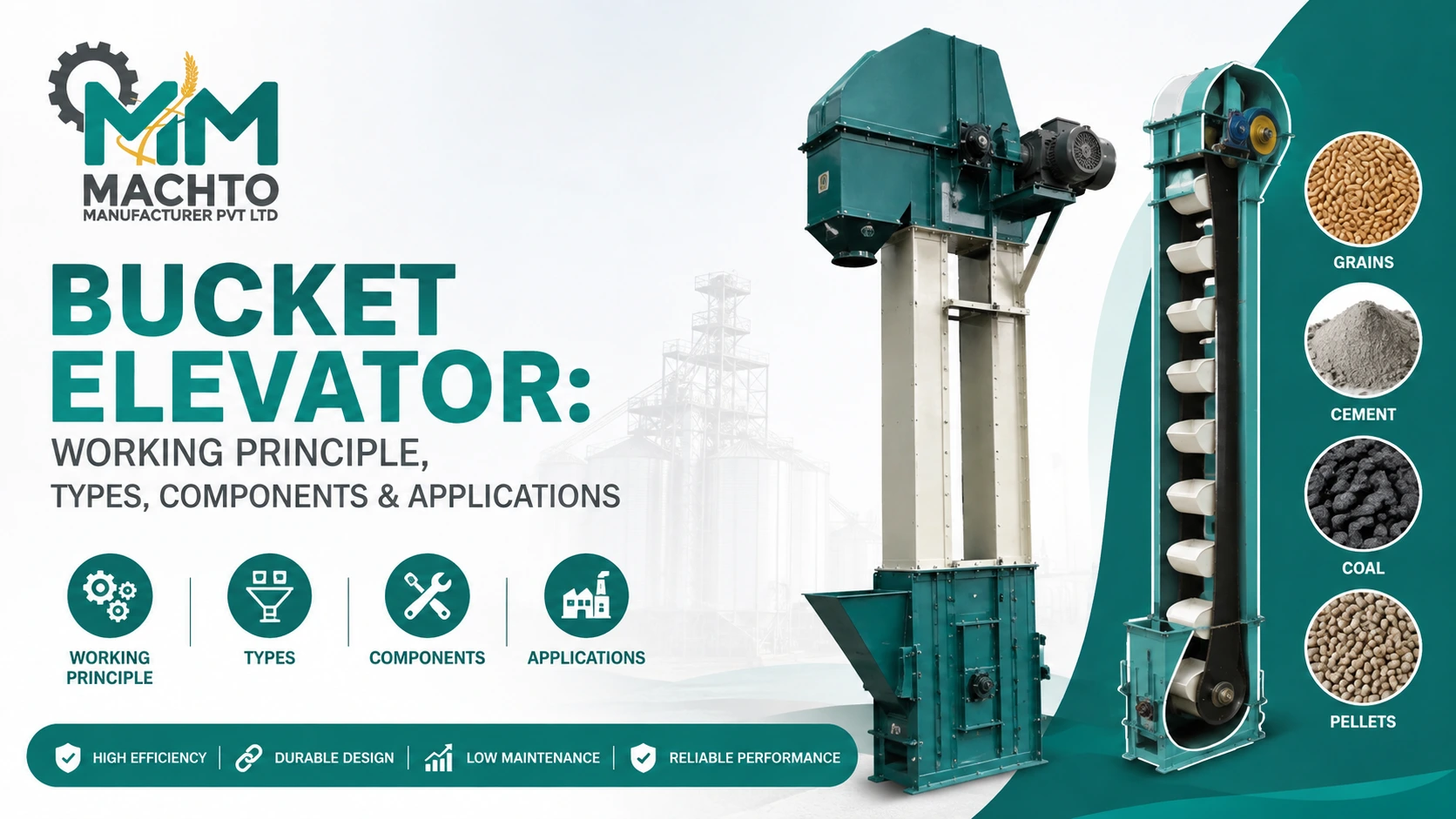
Moving bulk materials from one level to another can be challenging when conventional horizontal conveyors are not suitable. In industries where space is limited and vertical lifting is required, a bucket elevator provides an efficient and practical material-handling solution. It is commonly used for lifting grains, powders, fertilizers, chemicals, minerals, and other dry bulk materials to considerable heights.
For manufacturers and processing industries, selecting the right elevator is important because the equipment directly affects material flow, production capacity, energy consumption, and overall plant efficiency. Machto Manufacturer Private Limited provides industrial material-handling solutions designed according to specific application and capacity requirements.
This guide explains the bucket elevator working principle, major components, different types, applications, and important factors to consider before selecting one.
What Is a Bucket Elevator?
A bucket elevator is a vertical or inclined conveying machine designed to transport bulk materials upward using a series of buckets attached to a continuously moving belt or chain. Unlike conventional belt conveyors that generally move material horizontally or at a slight incline, a bucket elevator is specifically designed for vertical material lifting.
The buckets collect material from the feeding point and carry it upward. At the required height, the material is discharged into another conveyor, hopper, silo, storage system, or processing machine.
Because the material is carried in individual buckets, the system can handle a wide range of dry and free-flowing products while occupying relatively little floor space.
Also Read: What is a Vibro Destoner? Working Principle & Benefits
Bucket Elevator Working Principle
The basic bucket elevator working principle is simple but highly effective. A continuous belt or chain moves around two main pulleys or sprockets. Buckets are fixed at regular intervals along this belt or chain.
Material enters the elevator through the inlet section, where the moving buckets pick it up. As the belt or chain travels upward, the filled buckets carry the material vertically. When the buckets reach the top section, they move around the head pulley or sprocket.
During this movement, centrifugal force and gravity help discharge the material from the buckets through the outlet chute. The empty buckets then travel downward and return to the loading point, where the cycle starts again.
In simple terms, the working principle of bucket elevator involves four primary stages:
- Material feeding into the buckets
- Vertical movement of loaded buckets
- Discharge of material at the required height
- Return of empty buckets for the next cycle
The exact discharge method depends on the elevator’s design, speed, bucket arrangement, and material characteristics.
Main Components of a Bucket Elevator
A bucket elevator consists of several mechanical and structural components that work together to provide continuous vertical conveying.
1. Buckets
Buckets are the primary material-carrying components. They are attached to a belt or chain at suitable intervals. Bucket size, shape, and material are selected according to the product being conveyed and required capacity.
2. Belt or Chain
Depending on the elevator design, buckets may be mounted on a heavy-duty belt or one or more chains. Belt-driven systems are commonly used for lighter and relatively free-flowing materials, while chain systems can be selected for heavier or demanding applications.
3. Head Pulley or Sprocket
The head pulley or sprocket is located at the top of the elevator. It drives the belt or chain and supports the movement of buckets around the discharge area.
4. Boot Section
The boot is the lower section of the elevator. It generally contains the tail pulley or sprocket and provides the material inlet. Proper boot design helps the buckets collect material efficiently.
5. Casing
The elevator casing surrounds the moving buckets and belt or chain. It provides structural support and helps protect the moving components and conveyed material from external contamination.
6. Drive Unit
The motor and gearbox provide the required power to move the belt or chain. The drive arrangement is selected according to lifting height, capacity, material weight, and operating conditions.
7. Tensioning Arrangement
Proper belt or chain tension is necessary for smooth operation. A suitable tensioning system helps maintain correct alignment and minimizes slippage or excessive wear.
8. Inlet and Outlet Chutes
The inlet guides material into the elevator, while the outlet directs the lifted material toward the next stage of the process.
Types of Bucket Elevators
Different industries require different material-handling arrangements. Some common types include the following.
Centrifugal Bucket Elevator
Centrifugal bucket elevators generally operate at relatively higher speeds. Material is discharged from the buckets using centrifugal action as they move around the head pulley. They are commonly used for free-flowing materials such as grains and similar bulk products.
Continuous Bucket Elevator
Continuous bucket elevators operate at a comparatively lower speed and are designed to provide controlled discharge. Buckets are arranged closely together, reducing material spillage and making them suitable for fragile, abrasive, or difficult-to-handle products.
Belt Bucket Elevator
In this design, buckets are mounted onto a continuous belt. Belt bucket elevators are often selected for applications involving dry and relatively lightweight bulk materials.
Chain Bucket Elevator
Chain bucket elevators use chains to carry the buckets. They are suitable for applications where heavier loads, higher mechanical strength, or demanding operating conditions are involved.
Applications of Bucket Elevators
A bucket elevator can be used in many industries where vertical transportation of bulk materials is required.
Grain and Agriculture Industry
Bucket elevators are widely used for lifting wheat, rice, corn, seeds, pulses, and other agricultural products. They can be integrated with grain storage and processing systems.
Cement and Construction Industry
Dry powders and granular materials used in cement and construction processes can be transported vertically using suitable elevator configurations.
Fertilizer Industry
Fertilizer granules and other dry bulk products can be lifted between different processing or storage levels.
Food Processing
Food-processing plants use bucket elevators for handling products such as grains, cereals, seeds, and other dry ingredients. Hygienic construction and suitable materials can be selected according to the application.
Chemical Industry
Certain dry chemicals and granular products can be vertically conveyed using specially designed bucket elevators.
Mineral and Bulk Material Handling
Industries handling minerals and other bulk solids can use heavy-duty chain or belt elevator systems according to material characteristics.
Advantages of Using a Bucket Elevator
One of the biggest advantages of a bucket elevator is its ability to move bulk materials vertically while occupying relatively limited floor space.
Other benefits include:
- Efficient vertical material transportation
- Continuous conveying operation
- High lifting capability
- Compact installation footprint
- Suitable for different bulk materials
- Integration with automated material-handling systems
- Availability of belt and chain configurations
- Customizable capacity and lifting height
- Reduced manual material handling
When correctly designed and maintained, a bucket elevator can become an important part of an automated production and material-handling line.
How to Select the Right Bucket Elevator?
Choosing an elevator should not be based only on lifting height. Several technical factors should be considered before finalizing the equipment.
Material characteristics: Consider particle size, moisture, density, temperature, abrasiveness, and flowability.
Required capacity: Determine how much material needs to be transported per hour.
Lifting height: The vertical distance between the feeding and discharge points affects elevator dimensions and drive requirements.
Bucket size and spacing: These factors influence the conveying capacity and material handling performance.
Belt or chain selection: The choice depends on material weight, operating conditions, speed, and application requirements.
Discharge method: Centrifugal and continuous discharge arrangements can be selected according to material characteristics and process requirements.
Maintenance requirements: Easy access to bearings, drive components, buckets, and tensioning systems can simplify regular maintenance.
Why Choose Machto Manufacturer Private Limited?
Machto Manufacturer Private Limited focuses on providing industrial equipment and material-handling solutions for different manufacturing and processing applications. Our approach is based on understanding the customer’s material, capacity, layout, and operating requirements before selecting an appropriate equipment configuration.
A properly designed bucket elevator can be integrated with conveyors, hoppers, storage systems, processing equipment, and other material-handling machinery to create a smoother production flow. Customized design also allows the system to accommodate specific lifting heights, capacities, and installation conditions.
Conclusion
A bucket elevator is an efficient solution for industries that need to move bulk materials vertically with continuous and controlled operation. Its simple operating concept—collecting material in buckets, lifting it through a belt or chain, and discharging it at the required height—makes it suitable for a wide range of applications.
Understanding the bucket elevator working principle, components, types, and application requirements is essential before selecting the right equipment. From grain and agriculture to fertilizers, food processing, chemicals, cement, and mineral handling, the right elevator configuration can improve material flow while reducing manual handling and saving valuable floor space.
For businesses planning a new material-handling system or upgrading an existing production line, Machto Manufacturer Private Limited can provide application-focused solutions based on the required capacity, material characteristics, lifting height, and plant layout.