The quality of grains plays a an important role in the agriculture and food processing industries. Whether it’s rice, wheat, maize, pulses, coffee, sesame, or seeds, removing defective and lightweight materials is essential to ensure high-quality output. One of the most effective machines used for this purpose is the gravity separator machine.
A gravity separator improves product quality by separating materials based on their density or specific gravity rather than size. It helps eliminate immature grains, damaged kernels, empty seeds, stones, and other impurities that cannot be removed through conventional cleaning methods.
In this comprehensive guide, you’ll learn what a gravity separator machine is, how it works, its applications, benefits, and why it has become an essential part of modern grain and seed processing plants.
What is a Gravity Separator Machine?
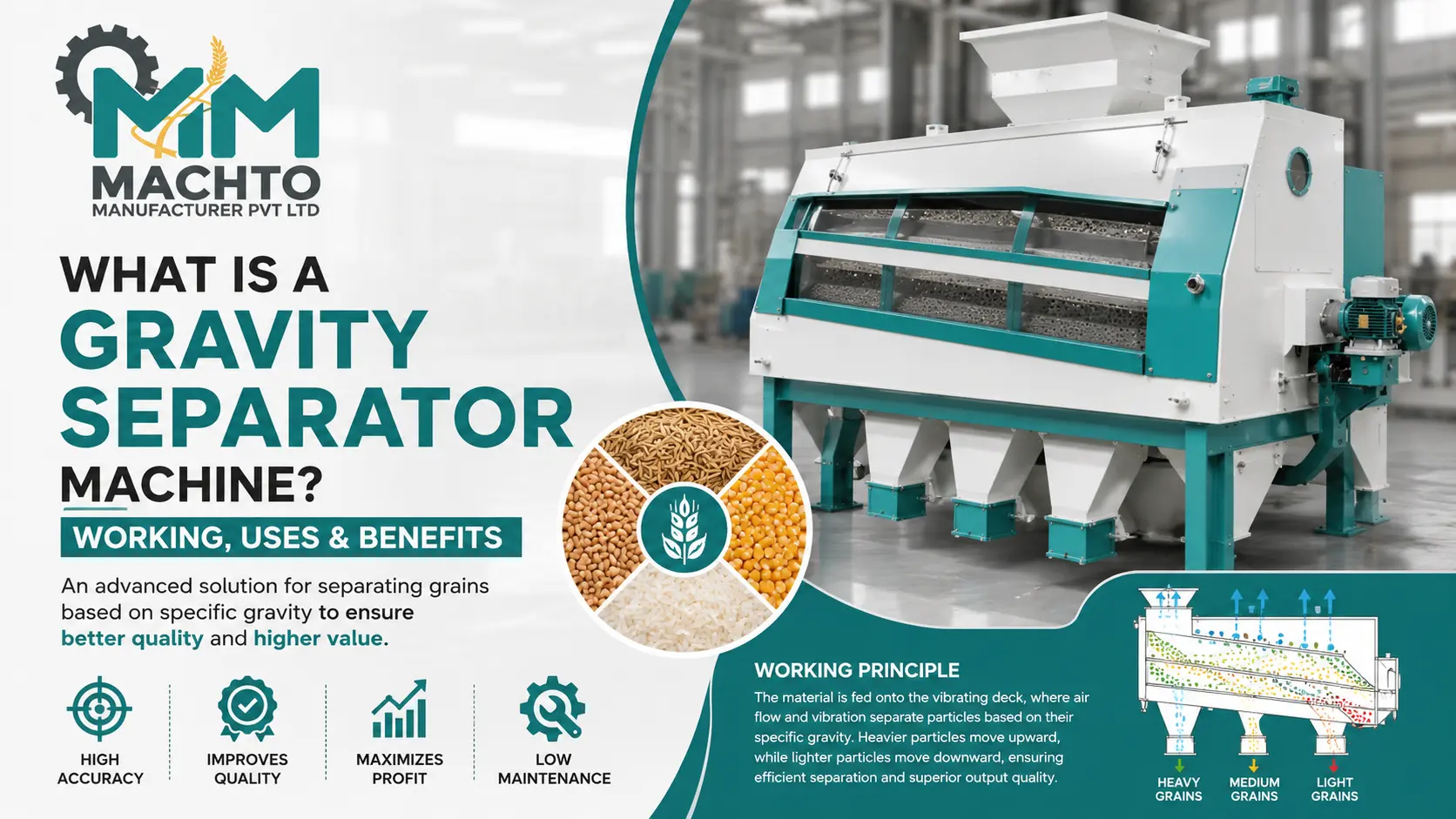
A gravity separator machine is an advanced grading machine that separates grains, seeds, and other agricultural products according to their specific gravity (density). The machine uses a combination of air flow, vibration, and an inclined deck to classify heavy and light materials.
Unlike sieves that separate materials by size, a gravity separator distinguishes products having similar dimensions but different weights. This allows processors to remove partially filled grains, insect-damaged kernels, immature seeds, and other low-density materials while retaining only premium-quality products.
Because of its precision and efficiency, the machine is widely used in rice mills, seed processing plants, grain cleaning units, flour mills, coffee processing facilities, and spice industries.
Also Read: What is the Paddy Separator Machine in The Rice Mill Plant?
How Does a Gravity Separator Machine Work?
The working principle of a gravity separator is based on specific gravity. Materials with higher density move differently from lighter materials when subjected to vibration and controlled air pressure.
The process involves the following steps:
1. Material Feeding
Raw grains or seeds are uniformly fed onto the vibrating deck through a controlled feeding mechanism.
2. Air Distribution
A blower pushes air upward through the perforated deck. The airflow lifts lighter particles while heavier materials remain in closer contact with the deck surface.
3. Deck Vibration
The deck vibrates continuously, causing the heavier particles to climb upward while lighter particles move downward.
4. Inclined Surface Movement
The deck is positioned at a slight angle, allowing materials to move naturally according to their density.
5. Final Separation
The machine discharges the materials into different outlets:
- Heavy and healthy grains
- Medium-quality grains
- Lightweight grains
- Damaged kernels
- Empty seeds
- Foreign particles
This process significantly improves the overall quality and value of the final product.
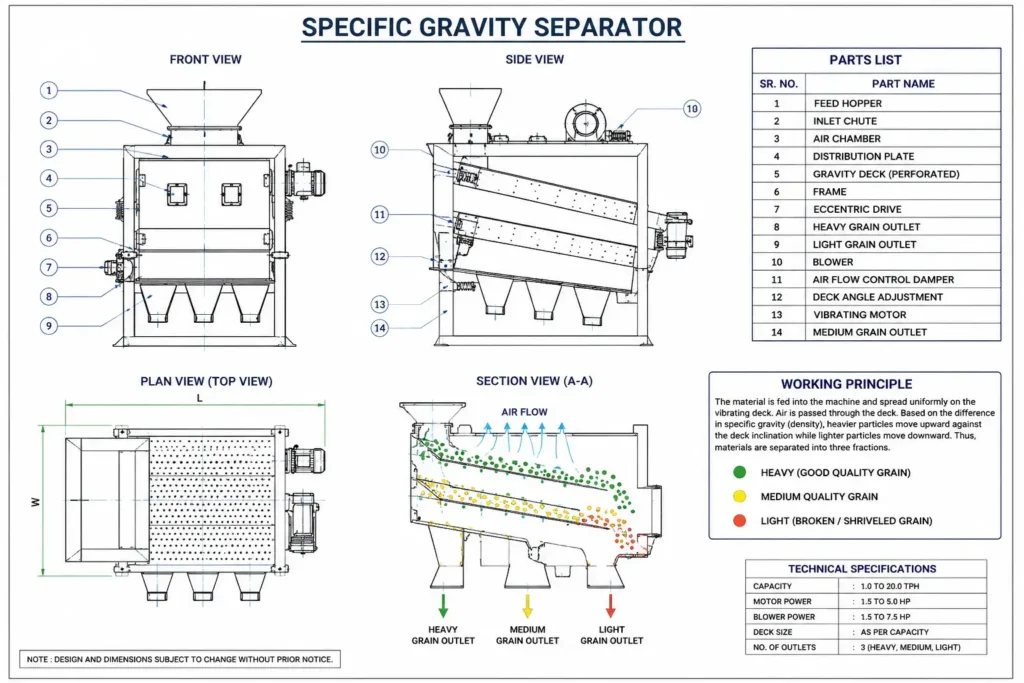
Specific Gravity Separator Diagram
A specific gravity separator diagram generally includes the following major components:
- Feed Hopper
- Vibrating Gravity Deck
- Air Blower
- Air Chamber
- Eccentric Drive Mechanism
- Inclined Deck Adjustment
- Heavy Grain Outlet
- Medium Grain Outlet
- Light Grain Outlet
- Dust Collection System
These components work together to create an efficient separation process based on density differences. The vibration, airflow, and deck inclination can be adjusted depending on the type of grain or seed being processed.
Main Components of a Gravity Separator Machine
A modern gravity separator consists of several precision-engineered components, including:
- Feed Hopper
- Gravity Separation Deck
- Adjustable Air Blower
- Vibrating Mechanism
- Deck Angle Adjustment System
- Collection Chambers
- Electric Motor
- Control Panel
- Dust Extraction Unit
Each component contributes to achieving accurate separation and consistent product quality.
Applications of Gravity Separator Machines
Gravity separators are widely used across multiple industries because they efficiently improve product quality.
- Rice Milling Industry- In rice mills, gravity separators help remove immature, damaged, and lightweight rice kernels, producing uniform and premium-quality rice.
- Seed Processing Plants- Seed companies use gravity separators to eliminate weak or damaged seeds, ensuring high germination rates and better crop performance.
- Wheat Processing- Gravity separators remove shriveled, insect-damaged, and lightweight wheat grains before flour production.
- Pulses Processing- The machine separates defective pulses from healthy ones, improving appearance and market value.
- Coffee Processing- Coffee processors use gravity separators to classify beans according to density, resulting in better roasting consistency and higher-quality coffee.
- Spice Industry- The machine removes lightweight impurities and damaged spices, ensuring superior product quality.
Benefits of Using a Gravity Separator Machine
Investing in a gravity separator machine offers several operational and commercial advantages.
- Superior Product Quality- The machine effectively removes defective grains and impurities, producing cleaner and higher-grade products.
- Higher Market Value- Premium-quality grains command better prices in domestic and international markets.
- Improved Processing Efficiency- By eliminating unwanted materials early in the process, downstream machines operate more efficiently.
- Reduced Product Loss- Accurate separation minimizes waste while maximizing recovery of valuable grains.
- Better Seed Germination- In seed processing plants, only healthy, high-density seeds are retained, improving germination performance.
- Increased Customer Satisfaction- Consistent product quality enhances customer confidence and strengthens brand reputation.
- Low Maintenance- Modern gravity separators are designed for continuous operation with minimal maintenance requirements.
- Long Service Life- Heavy-duty construction ensures durability and reliable performance even under demanding industrial conditions.
Factors to Consider Before Buying a Gravity Separator Machine
Before purchasing a gravity separator, consider the following factors:
- Processing Capacity (TPH)
- Type of Grain or Seed
- Separation Accuracy
- Airflow Adjustment
- Deck Size
- Energy Consumption
- Automation Features
- Build Quality
- Ease of Maintenance
- Spare Parts Availability
- Manufacturer Reputation
- After-Sales Service
Selecting the right machine ensures long-term performance and maximum return on investment.
Gravity Separator Machine vs Paddy Separator Machine
Many people assume these two machines perform the same function, but they serve entirely different purposes.
A gravity separator machine separates materials according to their density or specific gravity, making it suitable for removing lightweight or defective grains from healthy ones.
A paddy separator machine, on the other hand, separates unhusked paddy from brown rice after the dehusking process. It is an essential machine in a rice mill but operates on a different principle. Understanding this distinction helps businesses choose the right equipment for their processing requirements.
Why Choose a Modern Gravity Separator?
Modern gravity separators are equipped with advanced features such as:
- Precision vibration control
- Adjustable airflow system
- High-capacity processing
- Energy-efficient motors
- User-friendly controls
- Robust construction
- Low operating costs
- Consistent separation accuracy
These features enable industries to achieve higher productivity while maintaining excellent product quality.
Conclusion
A gravity separator machine is an indispensable piece of equipment for industries involved in grain, rice, seed, coffee, and pulse processing. By separating products based on density, it removes defective, immature, and lightweight materials that conventional cleaning equipment cannot effectively eliminate.
Whether you’re operating a rice mill, seed processing plant, or grain cleaning facility, investing in a high-quality specific gravity separator can significantly improve product quality, processing efficiency, and profitability.
At Machto Manufacturer Pvt. Ltd., we manufacture high-performance gravity separator machines engineered for precision, durability, and reliable operation. Our machines are designed to deliver consistent separation, maximize product quality, and support the evolving needs of modern agricultural and food processing industries.